Call centre:
22 201 36 60Contact us


Eneria / Energy Guide / Types of Hydrogen: Classification, Colors and Importance in the Energy Sector
Types of Hydrogen: Classification, Colors and Importance in the Energy Sector
11.09.2026
Polub artykuł, jeśli był pomocny.
Hydrogen is an exceptionally important energy carrier that is gaining strategic significance in the modernization of the fuel market. However, users often struggle to understand the differences between its various types. The distinction should be made both according to its physical state (gas, i.e., compressed hydrogen, and liquid hydrogen) and according to the industry classification based on colors, which indicate the environmental impact of hydrogen production methods. It is also important to distinguish the conventional color palette assigned to hydrogen gas from hydrides, which are actual chemical compounds formed by hydrogen and other elements.
What do hydrogen colors mean?
The color-based categorization is a purely conventional mechanism that helps the industry identify the extent to which a particular production technology impacts the environment. Although hydrogen gas itself is colorless, the assigned color makes it easier to assess the carbon footprint associated with its production method.
Hydrogen-related technologies are strongly linked to concepts such as the energy transition and decarbonization, ultimately leading toward the global goal of carbon neutrality. In Poland, the framework for these changes is defined by the Polish Hydrogen Strategy, which assumes that a sustainable hydrogen economy and modern hydrogen energy solutions represent the best path toward complete industrial zero-emission operations. Innovative hydrogen technologies are among the most important stages of this transformation.
How are green, gray and blue hydrogen produced?
To comprehensively answer the question “What are the main hydrogen production methods?”, it is necessary to list the most common processes:
- Water electrolysis
- Steam Methane Reforming (SMR)
- Methane pyrolysis
- Coal gasification
Green hydrogen is considered the most desirable and environmentally friendly option. It is produced by splitting water molecules using electricity supplied from renewable energy sources (RES) such as solar and wind power. The key device used in this process is an electrolyzer, and the most common technologies are alkaline electrolysis and PEM electrolysis.
Today, gray hydrogen dominates global industry. Unfortunately, it is highly unsustainable because it is produced from natural gas or other fossil fuels, resulting in significant carbon dioxide emissions. The primary method of production is Steam Methane Reforming (SMR), although other conventional methods, such as autothermal reforming, are also used.
Blue hydrogen is considered a transitional solution. It is produced in almost the same way as gray hydrogen, but manufacturers additionally install advanced carbon capture systems, including CCS (Carbon Capture and Storage) and CCU (Carbon Capture and Utilization) technologies. This CO₂ sequestration significantly reduces its environmental impact.
What are the other hydrogen colors?
The energy sector classifies hydrogen into many additional categories in its pursuit of an efficient and low-emission energy carrier. Hydrogen generated through hard coal gasification is referred to as black hydrogen, while lignite-based production results in brown hydrogen. White hydrogen, also known as natural hydrogen, occurs naturally and is trapped in geological underground formations.
Another alternative is methane pyrolysis, which produces turquoise hydrogen. Instead of harmful greenhouse gas emissions, the by-product of this reaction is solid carbon. Hydrogen produced using heat and electricity from nuclear power plants is referred to as pink, purple, violet, or red hydrogen. When the electricity used for electrolysis comes directly from solar energy, the result is yellow hydrogen.
Other environmentally friendly alternatives include hydrogen produced from biomass, commonly known as biohydrogen. It is also important to remember waste hydrogen, which is generated unintentionally in various chemical production facilities. Syngas (synthetic gas) is another valuable chemical product involved in these transformation processes.
What are the isotopes and chemical forms of hydrogen?
There are three isotopes of hydrogen:
Protium – the most common form on Earth, consisting of a nucleus with a single proton.
Deuterium – a stable isotope composed of one proton and one neutron, widely used in nuclear energy applications.
Tritium – an unstable radioactive isotope consisting of one proton and two neutrons.
It is also important to distinguish between molecular forms. Individual, highly reactive atoms constitute atomic hydrogen, which is unstable. In nature, hydrogen is most commonly found as a diatomic gas, known as molecular hydrogen (H₂). Within molecular hydrogen, specific nuclear spin isomers are distinguished and known as orthohydrogen and parahydrogen.
How does physical state affect hydrogen storage?
Producing hydrogen is only part of the challenge. Equally important are hydrogen storage and safe transportation. Today, the most common market standard is compressed hydrogen, which remains in gaseous form under very high pressures of approximately 350 bar (H35) or 700 bar (H70). This is the standard solution used at hydrogen refueling stations supporting hydrogen-powered transport. Modern hydrogen fueling stations operate under strict standards such as SAE J2601 and ISO 17268. Before the hydrogen is delivered to a vehicle, it is carefully purified, for example through PSA (Pressure Swing Adsorption) systems.
When maximum volumetric energy density is the primary objective, liquid hydrogen (LH₂) becomes the preferred solution. However, it requires cooling the gas to approximately -253°C and the use of highly specialized infrastructure, including dedicated cryogenic storage tanks. More common and easier-to-operate high-pressure solutions rely on the durability of reinforced pressure vessels.
Both gaseous and liquid hydrogen are highly effective energy sources for fuel cell systems, which convert hydrogen back into electricity. This is a key element of the power-to-gas concept, where renewable electricity is transformed into green fuel for energy storage and grid balancing purposes.
GEH2 Hydrogen Power Generator: A Zero-Emission Alternative for Business
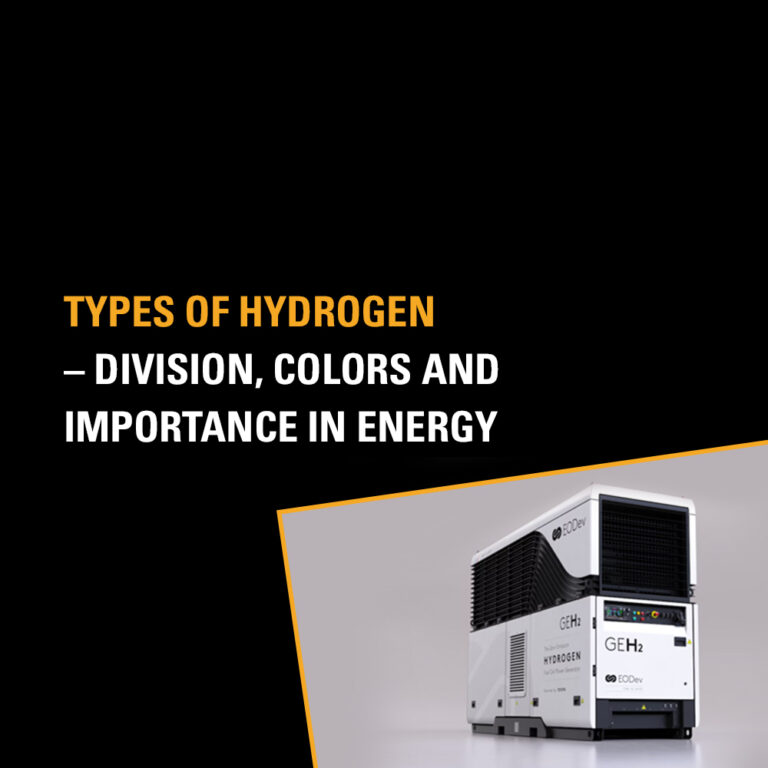
A practical example of hydrogen’s potential in the energy transition of enterprises is Eneria’s offer of the innovative GEH2 hydrogen power generator. This zero-emission unit, rated at 110 kVA (88 kW), is based on EODev technology and delivers completely clean electrical power. Its operation produces no carbon dioxide emissions, nitrogen oxides (NOx), particulate pollutants, or unpleasant odors. In addition, the generator operates quietly and starts instantly, while the heat generated by its air-cooled fuel cell can be recovered for heating applications through cogeneration.
The GEH2 hydrogen generator is an exceptionally versatile solution. It performs well in isolated locations such as islands and telecommunications relay stations, as well as in sensitive environments including enclosed spaces and tunnels. It can also be used on construction sites, at outdoor events, and in environmentally protected areas. It is equally effective as an emergency backup generator for critical infrastructure, including data centers, hospitals, airports, and banks. Equipped with intelligent onboard systems and a 4G communication module, it enables continuous fleet monitoring via the cloud, allowing users to track location, consumption, hydrogen reserves, and maintenance requirements.
Eneria plays a comprehensive role in implementing this innovation. As the official partner and distributor, the company not only supplies the generators but also assembles GEH2 units in its own production facility, performs rigorous testing, commissions the equipment on-site, and provides full warranty and service support. The adoption of such solutions in industry represents an important step toward building a modern, sustainable, and climate-neutral economy.
Rising energy prices, decarbonization requirements, and the increasing availability of renewable energy technologies are encouraging businesses to invest in solar energy. However, many people still use the terms “photovoltaic panel” and “solar collector” […]
The history of district heating systems in Nowy Targ was inseparably linked to the combustion of solid fuels for decades. Combined with the city’s geographical location in a basin, this created a major […]
What is Green Energy? Green energy is energy obtained from natural, renewable sources whose production does not generate harmful greenhouse gas emissions. A green energy package is one of the foundations of […]